
When you think of Africa, what comes to mind? The savannas of Kenya and South Africa with their lions, elephants, and giraffes? Maybe the rainforests of the Congo and Rwanda with their gorillas? The deserts of Algeria, Morocco, and Egypt with their camels, perhaps?
The island nation of Mauritius is very much a part of Africa, but it is nothing like any of those.
There’s definitely wildlife — in fact, Mauritius is home to some of the rarest plants and animals on Earth. And it’s even more than that.
Before the Portuguese arrived in 1507, there were no terrestrial mammals on the island, which meant that flightless birds and large reptiles could evolve there without threat. The dodo bird was unique to Mauritius until invasive species led to its extinction, and you’ll still see one on the country’s coat of arms.
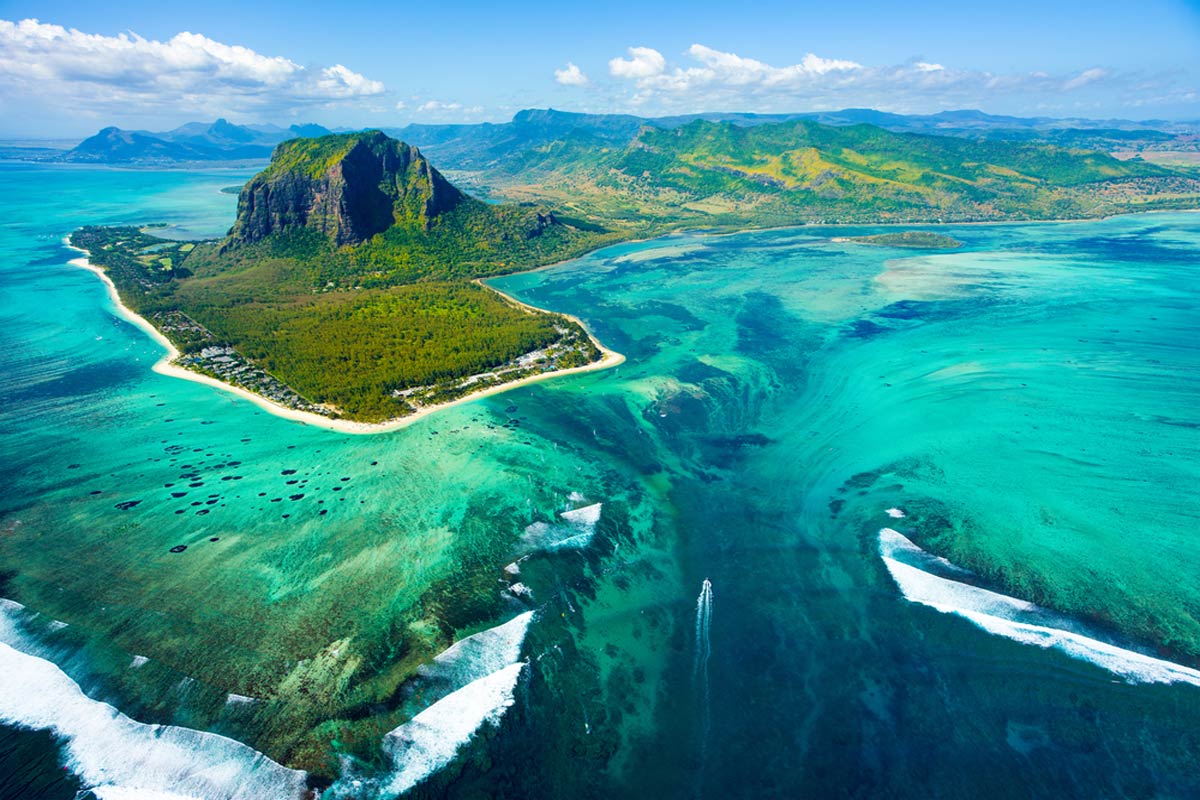
Aside from the dodo, Mauritius is perhaps most famous for its “underwater waterfall” off the southwestern coast of the main island. While it looks like pouring water, this optical illusion is actually created by sand and silt falling off the edge of an underwater plateau. You can hike to the top of Le Morne Brabant to see it, but the best views come from the air by helicopter or plane.

The underwater waterfall isn’t Mauritius’s only natural wonder. You’ll find Black River Gorges National Park, which was established in 1994 to protect much of the country’s remaining rainforest and all of its endemic bird species.


At Chamarel Seven Colored Earth Geopark, the brightly-colored dunes with red, brown, violet, green, blue, purple, and yellow volcanic sand are a popular tourist attraction. While we didn’t try it, it’s said that if you take a handful of sands of different colors and mix them together, they’ll ultimately separate into a layered spectrum.


Perhaps the most interesting historical experience we had was a visit to Aapravasi Ghat, otherwise known as the Immigration Depot. From 1849 to 1923, more than half a million Indian workers passed through Mauritius on their way to plantations owned by the British Empire around the world.
Located in the bay of Port Louis, the fortress is now a national monument and a UNESCO World Heritage Site. It is also an important part of many Mauritians’ personal heritage, since nearly 70 percent of of the country’s current population is of Indian ancestry.


For us, Mauritius was the starting point of the African portion of our fourth around-the-world circumnavigation. We were catching a cruise ship that would take us to Réunion, Madagascar, and South Africa before overlanding in Cameroon, Benin, Togo, Ghana, Nigeria, Ethiopia, Djibouti, Somalialand, and Uganda.
Then we planned a self-drive safari in South Africa, Lesotho, and Eswatini, followed by another cruise from the southernmost point in the African continent and up the west coast with stops in Namibia, Angola, Sao Tome and Principe, Cote d’Ivoire, Senegal, and into Europe via the Canary Islands and Portugal.
Cars, buses, and trains would take us from Portugal to Spain, Gibraltar, France, Italy, Slovenia, Croatia, Bosnia and Herzegovina, Montenegro, Serbia, Kosovo, Hungary, Czechia, and ultimately Germany, where we would board yet another ship taking us through Norway to the northernmost point of continental Europe, the Nordcap.
It was an incredible trip!
We are still working our way through thousands of photos and videos as well as hundreds of stories to share with you. In the meantime, we’ll leave you with these images from magical Mauritius, where we can’t wait to return.


Leave a Reply