
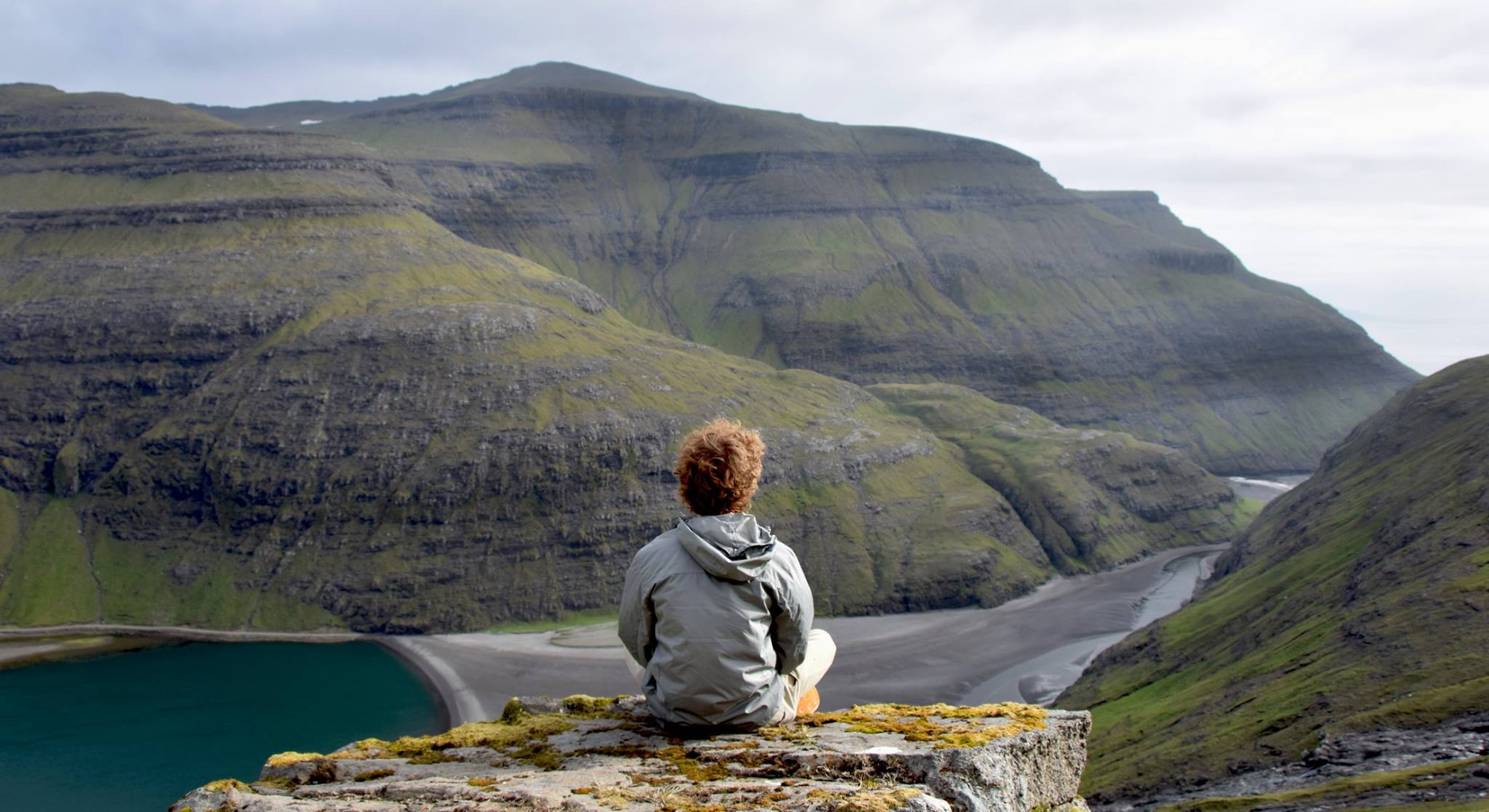
Our planet can be a very loud place. From the noise of big cities to the constant chatter of the digital world, it can sometimes feel difficult to find peace and quiet no matter where you are.
As someone who is partially deaf, I spend a lot of time trying to filter through noise to understand people and process experiences. I tend to appreciate quiet places the most, because I can relax into my other senses and fully take in my surroundings.
We’ve found a number of wonderfully hushed places in our travels, and these are some of our favorite quiet spots around the world.

Quiet Experience: Hiking Himakånå
Location: Nedstrand, Norway
What Makes It Special to Michael:
Mention Trolltunga, and most people can imagine the picturesque rock outcropping in Norway that hangs above a tranquil glacier lake. It springs to mind so readily because of the thousands of Instagram photos featuring the spot, many of which were taken after the subjects waited in line for several hours among the crowds. We were looking for the opposite of that.
When the Norwegians we met in Bergen had never heard of Himakånå, we knew we were on the right track. Himakånå, located in a tiny village with just over 200 residents, offers similar vistas of placid fjords. On our climb, the only sounds were sheep’s bells ringing softly in the hills. We were surrounded by deep green moss climbing every tree trunk.
And when we reached the top, the precipice of Himakånå jutted out over empty space, the water of the fjord undulating far below in the failing light.

This was the Norway we had come to see.
We lingered as long as we could and made the descent in near darkness, walking through starlit fields and feeling our way along the rocks and roots of the forest. We held hands as we ambled to the car and drove back to Bergen in satisfied silence, knowing that we had seen enough of Norway to guarantee our return.

Quiet Experience: Speaking with Spirits among Roman Ruins
Location: Timgad, Algeria
What Makes It Special to Angela:
“As was her habit, the ghost of Septima rose at dawn to look upon the majesty that once was Timgad and waited for the first visitors to arrive.”
Michael is a history scholar with a passion for Ancient Rome, and this was his proclamation as we first stepped foot on the Roman ruins of Timgad. The clank of armor and the cries from the marketplace had, of course, fallen silent centuries ago. But this remarkable site remained perfectly preserved beneath the sands of the Sahara for centuries, and during a modern-day visit, it was incredibly easy to imagine what it must have been like living there as a Roman citizen in 100 CE.

Long before New York City’s modern map, the straightforward orthogonal grid of Timgad’s streets carries you from the forum to the amphitheater and from the market to the baths, where you can sit on a second century toilet and ponder the mysteries of life just as you might today.
In addition to its extraordinary state of preservation, the most noticeable thing about these ruins is the lack of crowds you find swarming every similar site in Europe. Having the place all to yourself allows your imagination to tell you the stories of its former inhabitants in a way that truly brings history to life.

Quiet Experience: Kayaking with Icebergs
Location: Vernadsky Station, Galindez Island, Antarctica
What Makes It Special to Michael:
In the Southern Ocean, it feels like the flat-earthers might be right. The horizon is far too close and seems to drop precipitously into a glowing abyss. What is the name given to that fleeting shade of purple-blue-orange? I could see into that void if only I could paddle fast enough to make it to the edge before — like the end of a rainbow — it runs to give me chase.
We are in a sea kayak, following a group but purposefully lagging behind to let the others’ idle chatter evaporate in the thick, frozen air. It doesn’t take long before we can see them but not hear a word they say. Sound may travel quickly over water, but here it is dampened. Diminished. Drowned in a world that is decidedly nonhuman. Even the wind seems tentative and lacking in its bluster, moving in quiet awe of the sunlight’s dance on distant clouds and unnamed Antarctic mountaintops.
The gentle dip of oars and the occasional lap of water against the hull are the only sounds. Even my own breathing is absent in this place, and I know exactly what it is to be simultaneously insignificant and fully actualized. This peace is a gift. An experience shared but never shareable.

The silence is suddenly deepened and then held in stark contrast by the inversion of an iceberg, a momentary mountain groaning and rolling to upend itself and reveal its translucent blue underbelly.
The seabirds take flight, crying at the sudden disturbance like an audience calling for an encore, and then settle again on new perches, waiting for the world to turn and the endless, brilliant days to creak on.

Quiet Experience: Climbing to Where the Land Is Broken
Location: Faroe Islands, Denmark
What Makes It Special to Michael:
Maps have always fascinated me. As a kid, I would trace the outlines of countries and memorize capitals for fun, rolling the place names around on my tongue like they were delicacies. Imagining myself crossing some remote border. Disembarking from a lonely ship and wading ashore upon some wild island to disappear through the door of travel and find myself waiting there on the other side.
The obscure places were the best — magical names like Zanzibar, Borneo, and Aland. I sought those places on my maps, studying their contours and measuring the impossible distances from my home in rural Tennessee. And yet I had never heard of the Faroe Islands.
Somehow, this secluded Danish territory had eluded me until I came across stunning photographs as an adult. A rugged, broken archipelago with snow-capped green mountains and black cliffs falling sharply into a boiling sea. I had to see it for myself.
We explored the length and breadth of Streymoy island, taking in the scenery found on both the high roads through the mountains and the low roads hugging the coastlines. We climbed a thousand feet and spent an entire day hovering above the tiny town of Saksun, our only companions being the sheep and puffins who found us as curious as we found them.

Even at the iconic waterfall of Mulafossur and the southern edge of Lake Leitisvatn, where the water spills into the sea over a 100-foot cliff, we were the only humans around.
Over 50 million years ago, the volcanoes created this jagged landscape that seems to spring from the ocean to touch the sky. Climbing the mountains toward the clouds in silence, you feel like you just might be able to touch the sky as well.

Quiet Experience: Silencing the Signals of Communication
Location: Point Reyes National Seashore, Inverness, California, United States
What Makes It Special to Angela:
Dots and dashes. Signals and sound waves. Since Gugliemo Marconi heard the first tap come across his wireless telegraph in 1901, the noise of human communication hasn’t stopped.
The Radio Corporation of America, better known as RCA, purchased the Marconi Wireless Telegraph Company of America in 1920 and set up shop on California’s Point Reyes peninsula nine years later to improve its transmissions back and forth across the Pacific. They built an Art Deco-style receiving station and lined the access road with Monterey cypress trees planted to withstand the battering waterfront weather.
As communication progressed, telegraph technology became as dated as the building that housed it, and the last signal was transmitted in 1999. Once the height of modernity, it’s now a time capsule for the ‘20s that are no longer roaring.
But, as they say, silence is golden. And nowhere more so than the Golden State. We timed a hike for sunset and headed beyond the now-dead airwaves to Bolinas Point, where time seemed to slip further away.

Just before we reached the end of the trail above the beach, we stumbled across a sweet little shingled shack fit for a woodland fairy. It was a space designed for communication of a different kind — not with the world, but with one’s self. Inside, the floor was littered with stones and shells inscribed with messages of love and hope and encouragement from travelers who’d come before us. “Our spirit was here,” one read. And felt as though it remained.

Quiet Experience: “Hall of Observing in Quietness”
Location: Yu Yuan Garden, Shanghai, China
What Makes It Special to Angela:
With more than 26 million residents, it’s easy to feel as if you’ll never find a peaceful moment in Shanghai. Crowds on the metro. Crowds on the sidewalks. Crowds everywhere.
Originally a fishing village and market town, Shanghai hasn’t rested in centuries. That’s why Pan Yunduan created the Yu Garden during the Ming Dynasty in 1577 as a place of peace and comfort for his parents to enjoy in their old age. Even in the 16th century, they needed an escape from the city’s hustle and bustle.
In the northeast of Shanghai’s Old City, the garden’s 2 hectares (5 acres) are filled with traditional Chinese decorative halls, pavilions, ponds, bridges, and rockeries highlighted by sculptural trees and artistic plantings that show them in their best settings.

But the garden’s ultimate spot for tranquility is its “Hall of Observing in Quietness.” The Chinese are overt in their names. More than mere placeholders or suggestions, the name of a thing is intrinsic to both its form and its function. In China, names are not to be dismissed. As such, the Hall of Observing in Quietness sets the tone for intentionally reflecting a moment in silence amid the chaos of the city. To observe is to take notice. To behold with attention. To rest and renew along one’s spiritual journey.
As you wind your way further within Yu Garden, you move deeper into serene sanctuary that feels not just worlds but centuries away from where you began.

Quiet Experience: Diving the Hilma Hooker
Location: Kralendijk, Bonaire, Caribbean Netherlands
What Makes It Special to Michael:
Stories about quiet places typically don’t begin aboard pirate ships. One such vessel put to port in the Dutch Antilles in 1984. At the time, no one knew for certain that it was a pirate ship, but there was plenty of speculation.
The Hilma Hooker had a checkered past, sailing under many other names and for many questionable owners. It had already sank once, only to be revived like the crew of the Flying Dutchman to sail the seas again. The ship’s melancholy delivery, under tow, to the Caribbean island just off the coast of Venezuela would prove to be its swan song. Illegal drugs were found behind a false bulkhead, and the ship began to list from a slow leak in the hull.
Abandoned by its denizens and riding low, the Hilma Hooker drifted toward deeper water where it wouldn’t be a nuisance. And, under cover of night, it caught fire and sank for the final time.
For such chaos and uncertainty to describe the life of a ship, the Hilma Hooker is finally at rest. Ninety feet below the surface and slouched on its side, the skeleton now provides a tranquil wreck dive for those seeking silence beneath the surface of the sea. Between two coral reefs, its crew now consists of regal angelfish and eagle rays. The only sounds are your own breath and the gentle swish of the water as it finally offers peace to the pirates of the past.

Leave a Reply